Fishing Game RTP, Volatility and Hit Frequency: What a Philippine Session Can Show
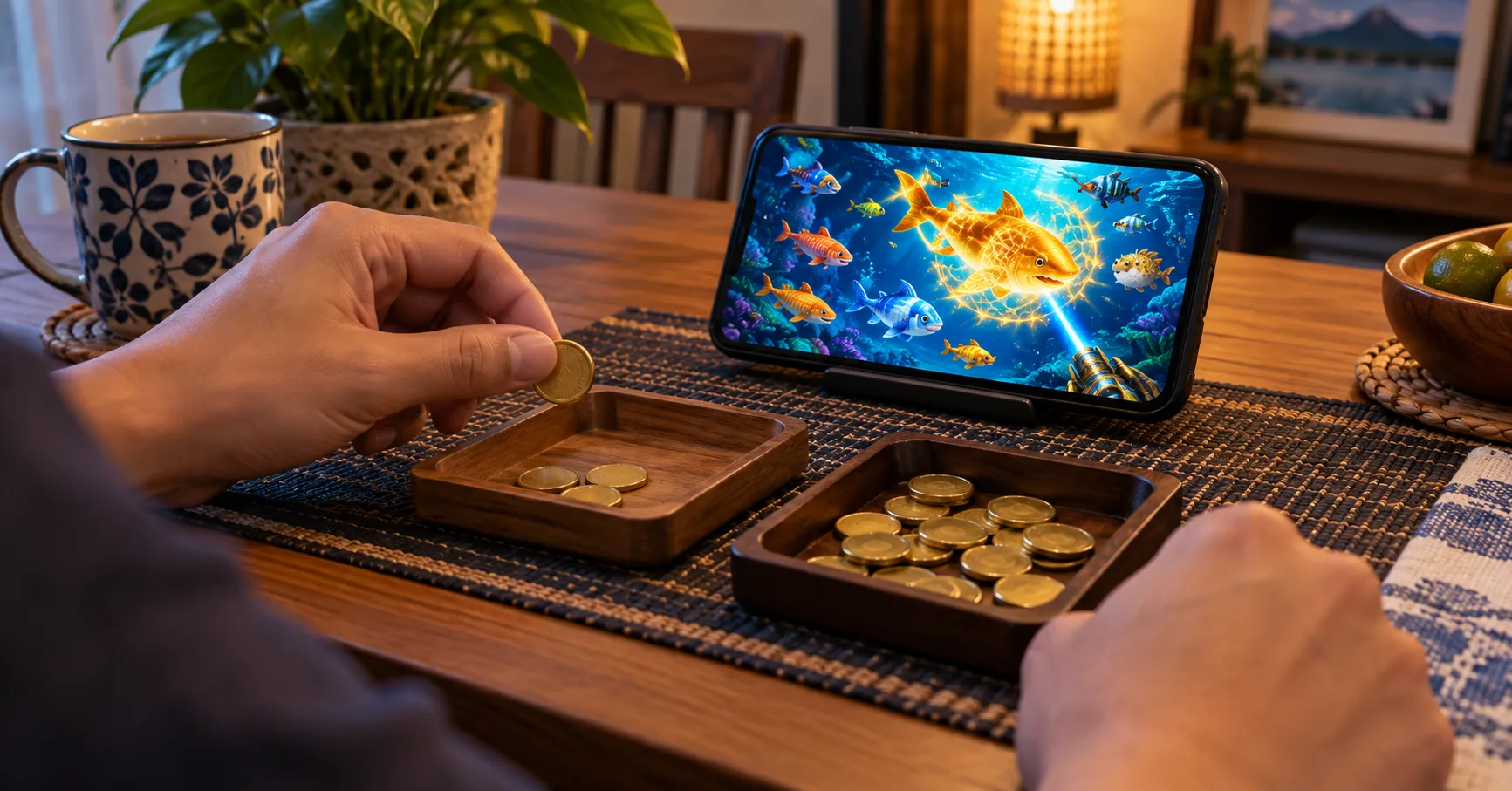
In a hypothetical Sunday Fishing Game session, a Philippine player recorded frequent target hits but finished with less money than they started with.
That outcome is possible because a visible hit, a credited catch and a profitable session are different things. Experienced players often know the advertised terms, yet still give a short run of results more weight than it deserves. The useful adjustment today is to measure what the game actually returns, while keeping long-run claims separate from the next shot. This matters on a phone, where a brief session and an interrupted connection can leave an especially misleading record.
Read RTP as an average over wagers, not a session forecast
Return to player, or RTP, describes a theoretical share of total wagers returned over a very large number of plays under a stated game configuration. If a game hypothetically had a 96% RTP, PHP 10,000 in total wagers would correspond to PHP 9,600 in theoretical returns and PHP 400 in theoretical loss. Those figures are an illustration, not the published RTP of any particular Fishing Game. One player can finish far above or below that average.
Wagers are also different from cash-in. A player might fund a wallet with PHP 500, win some credits, and stake those credits again. Total wagers could then exceed PHP 500 even though the original cash-in did not change. That distinction matters when someone tries to compare their wallet balance with a published RTP.
Before treating a displayed return figure as useful, check the following details in the information available for the particular game:
- Confirm that the figure belongs to the exact Fishing Game version and mode you are playing, rather than a similarly named title.
- Check whether the explanation defines the qualifying wager as each shot, another game action, or a different unit of play.
- Look for any separate payout rules for targets, weapons or modes that could change how your chosen actions are priced.
- Record when you checked the information, because a screenshot from an earlier session may not describe the game now open.
If those details are unavailable, an apparent RTP inferred from a short session is only your observed return. It cannot establish the game’s theoretical rate.
Build a return ledger from actual stakes
The cleanest session measure is credited returns divided by total stakes. Suppose, purely as a worked example, you make 100 shots costing PHP 5 each. You have staked PHP 500. If credited catches return PHP 450 altogether, your observed return is 90%, and you are PHP 50 down on those wagers. That calculation says what happened in this sample; it does not reveal the game’s RTP.
For a usable record, count the money moving through play rather than the number of exciting animations:
- Note your cash balance before the session and keep any promotional balance in a separate column or note.
- Add the cost of every completed shot to total stakes, including shots funded by credits won earlier in the session.
- Add only rewards actually credited to the playable balance, rather than amounts suggested by a target animation or sound.
- Mark any interrupted or unresolved shot separately until the account balance and game history show its final state.
- Calculate credited returns divided by total stakes, then compare the resulting net change with your opening and closing balances.
The two checks should broadly reconcile once cash-ins, cash-outs and other balance changes are accounted for. If they do not, investigate the missing entry before drawing conclusions about game performance. An Bonus can change a playable balance without changing the return distribution of the underlying game. Likewise, record Free Credits separately from cash funded through an e-wallet or payment centre, so a promotional credit does not get mistaken for a cash win.
Volatility determines how rough the route can feel
RTP says nothing by itself about the order or size of individual returns. Two games could have the same theoretical return while producing very different experiences. One might credit many small catches; another might rely more heavily on occasional large ones. The second can leave a player waiting longer and facing a larger drawdown before a substantial result appears.
Fishing Games can add another layer: shot cost and target choice may vary during play. Raising the cost of each attempt can make the wallet move faster, even when the underlying chance of a paid result has not improved. Switching targets after several misses may feel responsive, but the losses already incurred do not make the next target due to pay. A published volatility label, where one exists, is a broad description rather than a promise about how many shots a bankroll will last.
For a short Philippine mobile session, the practical question is whether the chosen shot cost leaves enough attempts to tolerate an ordinary run without credited catches. A PHP 500 wallet supports 100 attempts at PHP 5 each before returns, but only 25 attempts at PHP 20 each. That arithmetic is certain; the number of catches is not. Decide the maximum amount you can lose before increasing a stake, because a larger shot can shorten the session without repairing the earlier result.
Count credited catches, not flashes on the screen
Hit frequency is meaningful only after defining a hit. A projectile touching a target on screen may be a visual event. For financial tracking, the relevant event is a catch that posts a reward to the balance. Mixing the two makes the game appear to pay more often than your ledger shows.

Return to the earlier hypothetical session: 20 credited catches across 100 shots give a 20% observed paid-catch frequency. With PHP 450 returned, those catches averaged PHP 22.50 each. Now imagine one additional catch worth PHP 100. Paid-catch frequency rises only to 21%, while total returns rise to PHP 550 and observed return reaches 110%. A small change in frequency can accompany a large change in return when reward sizes differ.
Use the same definition throughout a comparison:
- Count a shot only when the stake was deducted and the attempt reached a recorded outcome.
- Count a paid catch only when its reward appears in the balance or an available transaction record.
- Keep visual contact, near misses and uncredited animations outside the paid-catch total, even if they looked successful.
- Compare sessions only when their shot costs and counting rules match closely enough to make the figures meaningful.
Even a carefully counted frequency from one evening is a sample, not a forecast. It cannot tell you that a cluster of misses must be followed by a catch.
When a mobile interruption corrupts the sample
Philippine players commonly move between home Wi-Fi and mobile data, including during weekend trips or evening sessions. A weak connection can make an animation stop while the account record continues elsewhere. The display alone may then leave you unsure whether the shot completed, whether a reward posted, or whether the balance simply has not refreshed. That uncertainty is an accounting problem before it is a mathematical one.

If a shot stalls, pause rather than immediately repeating the same action. Check the refreshed balance and any available game history, then record the attempt as completed or unresolved. Repeated taps during a delayed screen can create more stakes than you meant to place. A screenshot of the frozen screen may help reconstruct the sequence, but it does not prove the final outcome by itself.
The same care applies after a cash-in through an e-wallet or payment centre. Confirm what reached the playable balance before treating the deposit amount as your opening session balance. Payment timing and game return are separate measurements. Combining them can make a delay look like a gaming loss, or make a later credit look like a catch.
Use the figures to choose a limit, not a prediction
RTP, volatility and paid-catch frequency answer different questions. RTP describes a long-run mathematical average under stated assumptions. Volatility describes how uneven the path may be. Your observed hit frequency reports how often credited catches appeared in a defined sample. None identifies a profitable moment to start, a target that is now due, or a reliable stopping point after a losing run.
Before the next session, set a cash loss limit and a shot cost that fit the number of attempts you want to allow. Keep the same accounting method through the session, especially if you change targets or play across several short breaks. When the limit is reached, stop on the limit rather than on a belief that the recent sample must correct itself. Your ledger can explain what happened; it cannot make the next outcome predictable.